
006 - Helpful Articles
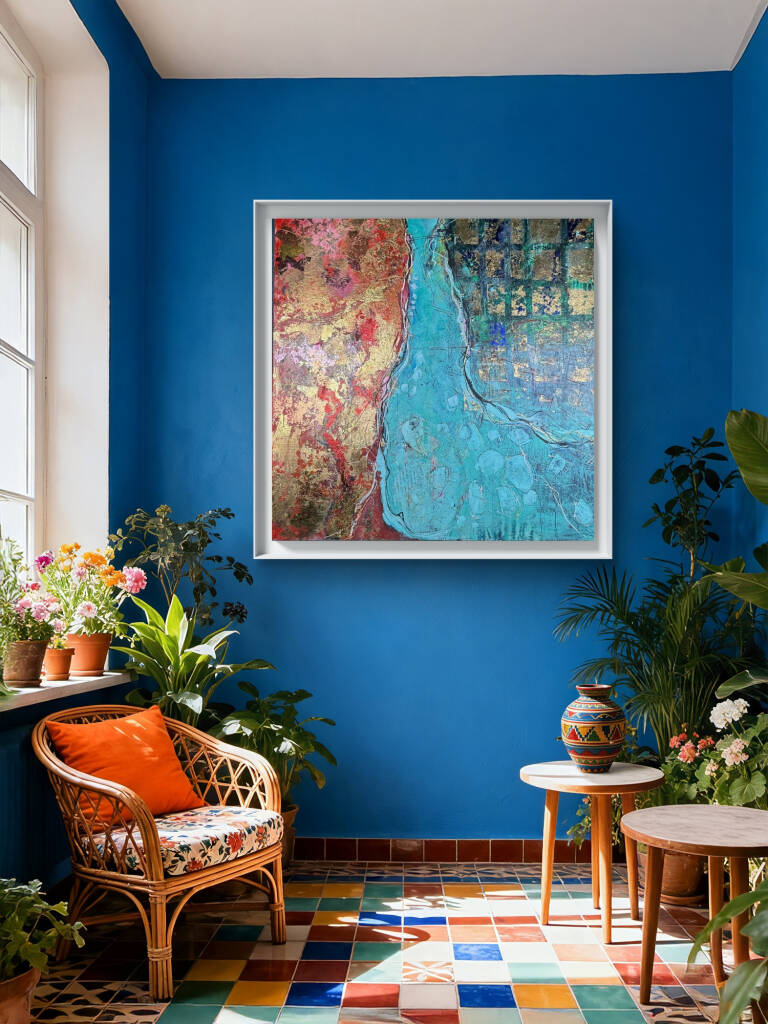
Knowing When to Stop: When Is an Abstract Painting Finished?
It’s a question I’m often asked, and a perfectly reasonable one. When you’re looking at an abstract painting, particularly one built from layers of colour, texture, collage and apparently spontaneous marks, how on earth does the artist know when to stop?
The honest answer is that there’s no universal formula. If there were, I’d have saved myself a considerable amount of paint over the years.
For me, a painting is finished when adding to it, or enhancing what’s already there, becomes superfluous. When another layer, another mark or another clever little intervention brings nothing of intrinsic value to the work, it’s time to put the tools down. The painting has said what it needs to say, even if I can’t entirely explain what that is.
But recognising that moment isn’t always straightforward.
Abstract painting is a process of discovery. I rarely know precisely where a piece will end up when I start. One decision leads to another, something unexpected happens, and occasionally a seemingly disastrous turn becomes the very thing that brings the painting to life. It’s a conversation between intention, instinct and the materials themselves.
The challenge is recognising when that conversation has run its course.
Other artists have their own ways of describing this moment. The painter Gerhard Richter has spoken about knowing a work is finished when he can no longer think of anything he wants to change. For British painter Ruth Calland, it’s a moment when the painting seems to settle into itself, revealing something that wasn’t anticipated at the outset. Different approaches, perhaps, but both recognise that completion is as much about judgement as it is about technique.
One of the greatest dangers is overworking a painting. There’s always something else you could do. Another splash of colour, a little more texture, a line to balance that awkward corner. But being able to add something doesn’t necessarily mean you should. Sometimes the next mark adds nothing. Sometimes it destroys something you didn’t realise was working.
I’ve learned that stepping away can be as important as picking up a brush. A little distance allows me to see the painting afresh, rather than through the accumulated decisions that created it. If it still feels resolved when I return, that’s a pretty good indication that it’s time to stop.
And perhaps that’s the important distinction. A painting doesn’t have to be perfect, or even entirely predictable, to be finished. It simply needs to reach a point where its elements belong together, where the tensions, contrasts and textures hold their own, and where further intervention risks taking more away than it gives.
Ultimately, knowing when to stop is something you develop through experience. You learn to trust your instincts, recognise your own habits and accept that not every uncertainty needs to be resolved.
Sometimes the most important decision an artist makes isn’t what to put on the canvas next.
It’s knowing when to leave it alone.
October 2027